Executive summary
This is not a hustle story. It is an engineering postmortem.
Between late 2023 and November 2024, I built and sold Hydra / XLeadScraper — distributed data infrastructure that reached roughly $500k ARR in six months and sustained 2M+ requests/day at peak. In November 2024, 𝕏 issued a cease-and-desist. Developer accounts were terminated, API access revoked, and 30+ customer accounts were caught in the blast radius of shared infrastructure.
The useful output is not the revenue headline. It is what the failure modes teach about platform detection, architectural isolation, and compliance as a design constraint.
Structured report: github.com/Vinaygond/The-500K-C-D-Report
Interactive version: The-500K-C-D-Report site (HTML + charts)
V2 product (post-pivot): xleadscraper.com
Business context
I started with almost no runway — a young family, limited local opportunity, and a clear market pain: agencies and founders needed structured lead intelligence from public social signals faster than manual workflows could deliver.
V1 monetized through high-ticket licenses. Customers paid for throughput and precision. That market pressure rewarded:
- Faster ingestion
- Broader coverage
- Higher daily volume
- Shorter time-to-result
Under that pressure, the system optimized for throughput first. Compliance, per-user isolation, and behavioral realism were deferred — not because they were unknown, but because they were treated as problems to solve later.
That deferral worked until it did not.
What V1 proved (technically and commercially)
V1 was a legitimate distributed-systems win in several dimensions:
| Dimension | Result |
|---|---|
| Orchestration | Request routing across ~47 API surfaces instead of one rate bucket |
| Scale | ~247 auth tokens, ~1,200+ rotating IPs, queue-driven workers |
| Throughput | ~2M requests/day at peak |
| Commercial | ~$500k ARR within ~6 months |
| Product | NLP intent scoring converted volume into higher-signal output |
A single founder can design infrastructure at millions of requests per day. A focused automation product can reach significant ARR quickly.
But orchestration without isolation creates correlated failure.
The reset (November 2024)
The legal notice forced a hard stop — not just on features, but on design philosophy.
The C&D cited unauthorized scraping, Terms of Service violations, and platform manipulation. My account was banned. Shared developer tokens were revoked. Customers who depended on the same infrastructure were suspended.
The real cost was not the letter. It was trust: 30+ customers who chose my architecture and paid the price when the network-level correlation layer fired.
Cease-and-desist correspondence (redacted preview)
Screenshots from the November 2024 legal notice — included as primary-source context for this postmortem. Personal addresses and unrelated identifiers are redacted in the originals.

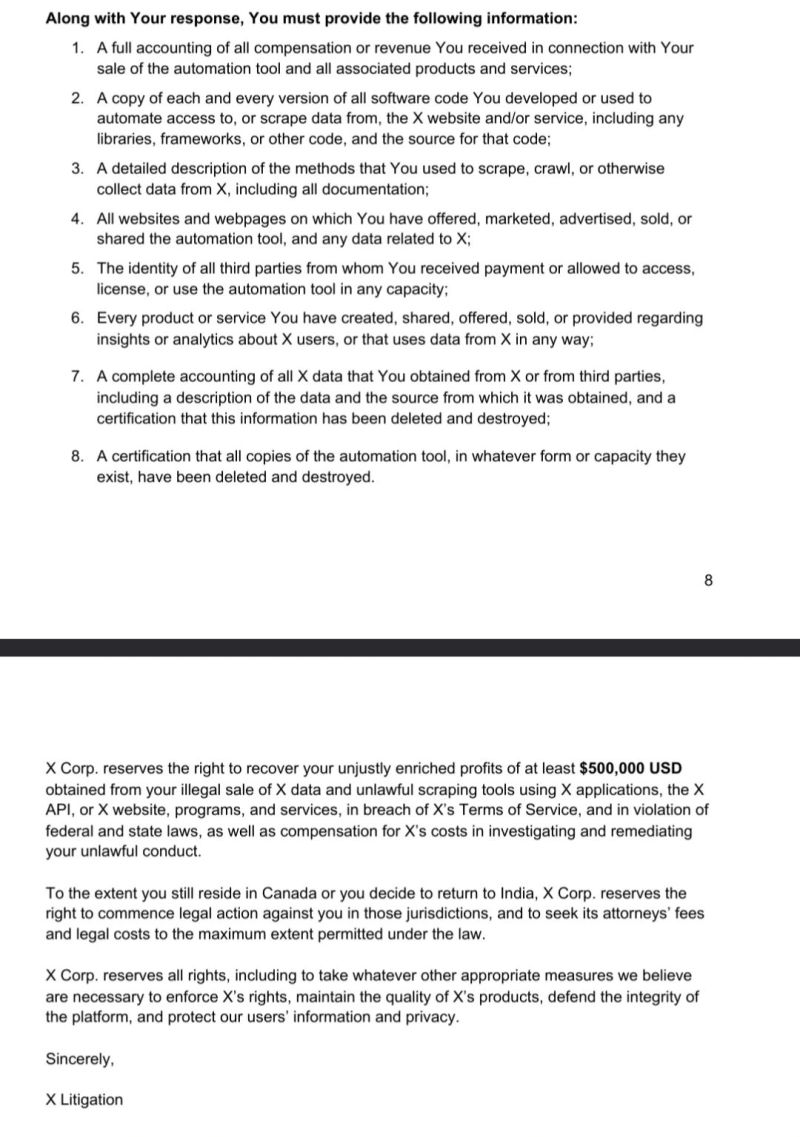
These images document the reset event referenced throughout The $500K C&D Report. They are shared for engineering context, not as legal advice or an invitation to repeat V1 architecture.
The four-layer model (why V1 ended)
Platform enforcement is rarely one-dimensional. In this case, detection stacked in four layers:
Layer 1  Per-endpoint rate limits          (obvious)
Layer 2  Per-IP / per-token scoring        (less obvious)
Layer 3  Behavioral anomaly detection      (where V1 broke)
Layer 4  Network-wide pattern correlation  (where V1 ended)
V1 addressed Layers 1–2 aggressively. Layers 3–4 are where durability collapsed.
Full breakdown: docs/detection-layers.md
What changed in V2
V2 is not “V1 with better rate limits.” It is a different system:
| Design choice | V2 approach |
|---|---|
| API access | Official paths, conservative utilization (~≤50% of limits) |
| Identity | One license → one user OAuth; no shared token pools |
| Network | No shared residential proxy mesh |
| Timing | Randomized delays, idle blocks, mixed activity types |
| Isolation | Per-user workloads; no coordinated target patterns |
| Output | Qualified leads over raw volume |
Peak throughput dropped from ~2M/day to ~10k profiles/day per user. Operationally, that is an upgrade: customers can actually use the output, and the system can keep running.
Most customers did not need 2M profiles/day. They needed 50–200 qualified leads/day with follow-up capacity. Speed had become a vanity metric.
Portable lessons (now applied at Exit Protocol)
These lessons transferred directly into my current work on Exit Protocol:
| Lesson from V1/V2 | Application in Exit Protocol |
|---|---|
| Blast-radius control | Matter-level data isolation, scoped deployments |
| Deterministic outputs | LIBR tracing engine; legal math not delegated to LLMs |
| Reviewable artifacts | Attorney-reviewable workpapers with provenance |
| Integrity records | SHA-256 snapshot sealing and exact file-hash verification |
| AI boundaries | AI for messy documents; deterministic systems for proof |
| Constraints as design | Compliance, policy, and legal context shape architecture |
Use AI where it accelerates judgment. Use deterministic systems where proof requires precision. Treat constraints as architecture inputs, not obstacles.
That is the line from XLeadScraper V2 to Exit Protocol.
Verified public discussion
The story was discussed publicly on founder forums (including Swapd), where moderators and readers validated key claims about scale and outcome. I treat those threads as third-party context, not as operational documentation.
Closing
The $500K number gets attention. The useful part is what came after: a compliance pivot, a public engineering artifact, and infrastructure work where auditability and boundaries are product requirements.
Vinay Kumar Gond
vinay@exitprotocols.com · vinaygond.github.io · exitprotocols.com