Long-form analysis on systems problems where correctness, auditability, and trust boundaries matter. These are engineering research notes — not peer-reviewed papers, not legal advice, not product marketing.
Index
| Study | Focus | Date |
|---|---|---|
| Forensic Accounting Pipeline | LIBR tracing, OCR, evidence integrity | Mar 2026 |
| Platform Detection & Blast Radius | Four-layer enforcement, V1/V2 pivot | Nov 2025 |
| Subscription Media Leakage | DRM, access control, incentives | Feb 2024 |
Related: Projects · Technical stack · Exit Protocol · $500K C&D Report
Case Study: The Algorithmic Transformation of Forensic Accounting
- Date: March 2026
- Focus: Distributed systems, OCR pipelines, deterministic asset tracing, evidence integrity
- Implementation: Exit Protocol
- Paper: Read the full PDF
- Product case study: Blog post
Abstract
High-conflict financial litigation often depends on one difficult task: proving where money moved, what remains traceable, and whether assets were hidden, commingled, or depleted.
Today, that work is still largely manual. Attorneys and forensic accountants review PDFs, rebuild account histories in spreadsheets, and trace funds transaction by transaction. The process can take weeks, cost tens of thousands of dollars, and still remain vulnerable to human error.
This research explores how forensic accounting can be rebuilt as a deterministic software pipeline — structured ingestion, OCR-assisted extraction, state-machine tracing, and cryptographic evidence sealing — so review cycles compress without sacrificing explainability.
Use AI to accelerate document understanding. Use deterministic systems where legal proof requires precision.
Scope note: Exit Protocol V1 focuses on single-claim LIBR tracing workpapers. Outputs are attorney-reviewable structured review material — not legal advice, expert opinion, or court filings.
1. The bottleneck of manual tracing
Traditional workflows rely on human reviewers to extract data from bank statements, normalize transactions, reconstruct timelines, and apply accounting rules across years of activity.
Structural problems:
- High cost — complex cases can exceed $50,000 in forensic accounting fees
- Human error — spreadsheet workflows fracture across accounts and date ranges
- Access asymmetry — deeper analysis favors the party that can afford it
- Slow cycles — attorneys wait weeks for a usable financial picture
- Weak auditability — manual conclusions are hard to reproduce
The replenishment fallacy is especially dangerous: assuming later deposits restore previously depleted separate-property funds. In LIBR tracing, that error can invalidate the entire analysis.
The problem is architectural, not just financial.
2. Proposed architecture: deterministic financial tracing
A forensic system useful in litigation cannot be a black box. Results must be explainable, repeatable, and tied to underlying evidence.
Pipeline sequence:
- Ingest financial records
- Extract structured transaction data
- Normalize dates, amounts, descriptions, balances
- Reconcile account timelines
- Apply deterministic tracing rules
- Generate reviewable outputs
- Seal the evidence package cryptographically
LIBR (Lowest Intermediate Balance Rule) modeled as a state machine:
S_t = min(S_{t-1}, B_t)
S_t— traceable separate-property balance at timetS_{t-1}— previous traceable balanceB_t— account balance at timet
The system follows the math; it does not invent conclusions.
Public LIBR reference implementation
3. OCR and document intelligence
The hardest part is not the tracing formula — it is the input. Evidence arrives as scanned PDFs, degraded tables, inconsistent formats, and multi-page discovery packets.
Requirements beyond basic OCR:
- Spatial table extraction and transaction row reconstruction
- Date, amount, balance, description parsing
- Duplicate detection and account-level reconciliation
- Human-review checkpoints for ambiguous records
- Clear separation: extracted data → human edits → computed outputs
AI/OCR reduce document chaos into review surfaces. Tracing logic stays deterministic.
4. Zone of Truth simulation
Banking records often lack intra-day ordering. Multiple transactions share a date without reliable timestamps — creating ambiguity in balance-sensitive tracing.
Instead of pretending order is knowable, model the uncertainty. Zone of Truth runs plausible ordering scenarios (conservative and favorable) to bracket the possible traceable balance.
Reviewers get an honest answer:
- What is definitely traceable?
- What is potentially traceable?
- Where does ambiguity remain?
- Which missing records would narrow the range?
Acknowledging uncertainty is stronger than hiding it.
5. Cryptographic chain of custody
SHA-256 hashing on data snapshots and report artifacts detects later modification.
Preserved records:
- Source-document references and processing history
- Extracted transactions, human edits, review notes
- Computed tracing outputs and versioned report artifacts
- Hash-sealed final dossiers
The question is not only what did the system find? — it is can we prove how it got there?
6. Sovereign deployment and sensitive data
Financial litigation involves bank accounts, income, transfers, family assets, and sometimes coercive control. Privacy is foundational.
Deployment models supporting:
- Private infrastructure and containerized execution
- Firm-controlled storage and bring-your-own-key options
- Matter-level data isolation, audit logs, access controls
- Reduced exposure to unnecessary third-party systems
Especially relevant where attorney-client privilege, financial privacy, and personal safety intersect.
Conclusion
Forensic accounting should not depend entirely on who can afford weeks of manual spreadsheet reconstruction.
The future is not a black-box AI report. It is a structured evidence pipeline: machine-assisted where documents are messy, deterministic where law requires precision, cryptographically sealed where trust matters.
Analysis by Vinay Kumar Gond · Projects · Technical stack
Case Study: Platform Detection and Architectural Blast Radius
- Date: November 2025 (ongoing documentation)
- Focus: Multi-layer platform enforcement, throughput vs durability, compliance pivot
- Artifact: The $500K C&D Report
- Blog: Postmortem summary · Technical deep-dive
Abstract
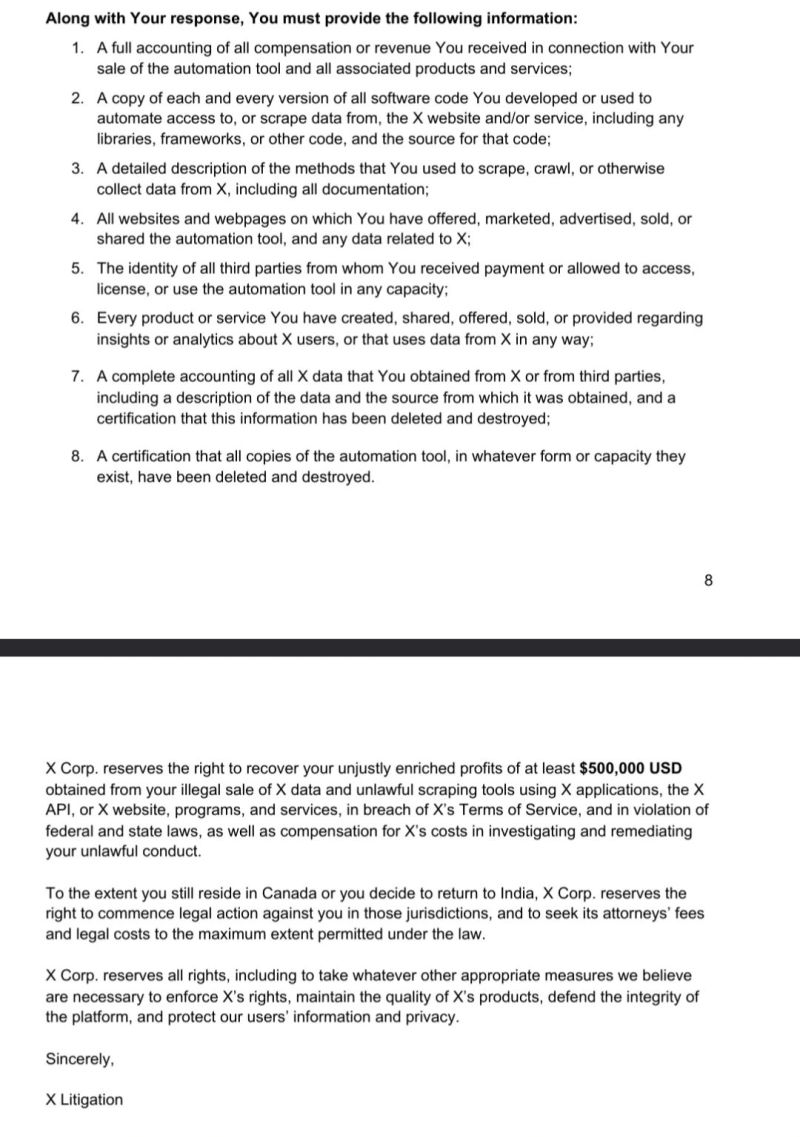
This case study documents what happened when a distributed data product scaled faster than its compliance and isolation boundaries could support — roughly $500k ARR in six months, 2M+ requests/day at peak, and a platform cease-and-desist in November 2024.
The cease-and-desist was not the story. It was the invoice for architectural debt.
Primary source — November 2024 legal notice (redacted screenshots):

The four-layer model
Platform enforcement stacks — beating Layer 1 alone does not create durability:
| Layer | Mechanism | V1 outcome |
|---|---|---|
| 1 | Per-endpoint rate limits | Addressed via endpoint rotation |
| 2 | Per-IP / per-token scoring | Delayed via proxy/token mesh |
| 3 | Behavioral anomaly detection | Failed — throughput-optimized timing |
| 4 | Network-wide correlation | Terminal — shared infrastructure blast radius |
Key findings
- Throughput ≠ architecture — orchestration without isolation creates correlated failure
- Shared infrastructure converts individual risk into systemic risk — 30+ customers affected
- Speed became a vanity metric — most customers needed 50–200 qualified leads/day, not 2M profiles
- Compliance is a design constraint — V2 rebuilt around single-user OAuth, per-tenant isolation, conservative API utilization
Portable lessons (applied at Exit Protocol)
| Lesson | Exit Protocol application |
|---|---|
| Blast-radius control | Matter-level data isolation |
| Deterministic outputs | LIBR engine; legal math not in LLMs |
| Reviewable artifacts | Attorney-reviewable workpapers + provenance |
| Integrity records | SHA-256 sealing, exact file-hash verification |
| AI boundaries | AI for documents; determinism for proof |
Full report · Detection layers doc · Builder checklist
Analysis by Vinay Kumar Gond · Projects
Case Study: Content Leakage Vectors in Subscription Media
- Date: February 2024
- Focus: Digital rights management, platform security, access control, market incentives
Abstract
Subscription media platforms face a structural security problem: once access is granted, content is often treated as permanently available — even when the creator intended limited or conditional access.
The issue is architecture, not only piracy. Platforms optimize for delivery speed and CDN efficiency, which can produce long-lived access links, weak traceability, insufficient watermarking, and poor economic deterrence against redistribution.
1. The structural problem
Bulk archive access creates:
- Bulk access risk — short subscriptions expose large historical libraries
- Weak traceability — leaked content is hard to source to an account
- Creator trust decay — platforms cannot enforce meaningful accountability
Leakage is often treated as moderation after the fact. Stronger systems treat it as access-control and incentive design from the start.
2. Static vs dynamic access
Static: authorize once, serve forever.
Dynamic: who is requesting, what are they entitled to, for how long, under what conditions, can this copy be traced, can access be revoked narrowly?
3. Proposed architecture: atomic content access
Move from unlimited archive defaults to per-object, time-limited, traceable access:
- Encrypted storage at rest
- Just-in-time authorization per media object
- Short-lived, narrowly scoped delivery tokens
- Forensic watermarking (visible + invisible per-user markers)
- Access logging for audit and abuse investigation
- Rate-aware bulk-viewing friction
- Creator-selectable protection tiers
Goal: change the economics of redistribution — make leakage traceable, risky, and expensive. No system prevents screenshots entirely.
4. Watermarking and accountability
Combine visible deterrence, invisible per-user fingerprints, session markers, delivery-time transformation, device correlation, and audit logs tied to unlock events. Enforcement shifts from guesswork to evidence-backed action.
5. Market impact
Creators: higher trust, premium protection, flexible monetization, stronger abuse evidence.
Platforms: lower moderation burden, creator retention, security as differentiator.
Users: clearer rules, fewer blanket restrictions from minority abuse.
Conclusion
Creator security at scale is a distributed systems problem: encryption + short-lived access + watermarking + audit logs + incentive-aware product design.
Analysis by Vinay Kumar Gond · Technical stack
Research principles
Across all studies, the same discipline applies:
- Bounded claims — document what happened, not what sounds impressive
- Explainability — reviewers must understand how conclusions were reached
- Determinism where proof matters — probabilistic tools stay in assistive roles
- Constraints as inputs — platform policy, legal context, and privacy shape design
Contact: vinay@exitprotocols.com · LinkedIn · GitHub
Last updated: July 2026