Selected work across forensic litigation intelligence, high-throughput distributed infrastructure, public engineering postmortems, and security research. Every project below ships or documents real systems — not concept decks.
Quick navigation: Exit Protocol · Hydra / XLeadScraper · $500K C&D Report · Forensic Accounting Research · Content Security Research · ZeroTrace
Exit Protocol
Forensic Litigation Intelligence · Active Development (US Beta)
| Role | Founder & systems architect |
| Site | exitprotocols.com |
| Focus | Single-claim LIBR tracing workpapers, evidence integrity, attorney-reviewable outputs |
Problem: High-conflict divorce and asset disputes depend on tracing where money moved — but manual forensic accounting is slow, expensive, and hard to audit. Bank statements arrive as messy PDFs; commingled accounts require strict mathematical tracing.
What it does: Exit Protocol converts financial records into structured, reviewable evidence. AI assists document ingestion and classification; deterministic engines handle LIBR tracing, ledger consistency, and workpaper generation. Outputs are structured review material for counsel and retained experts — not legal advice, expert opinion, or court filings.
Core systems:
- LIBR Tracing Engine — Deterministic Lowest Intermediate Balance Rule state-machine; visible strategy, ledger agreement, source provenance on the workpaper face.
- Document Ingestion — OCR-assisted extraction from PDF statements and discovery packets; normalized transaction timelines.
- Evidence Integrity — SHA-256 snapshot sealing, exact file-hash verification, processing history.
- Shadow Report — PDF metadata, ghost text, redaction artifact, and structure inspection.
- Sovereign Deployment — Containerized private deployments for sensitive legal and financial data.
- B.I.F.F. Suite — AI-assisted communication rewriting for high-conflict correspondence (review aid, not legal advice).
Stack: Python Django PostgreSQL Celery Redis Docker OCR Mistral/Gemini AES-256 SHA-256
Product · Architect profile · LIBR demo · Case study post · Research
Hydra / XLeadScraper
High-Throughput Data Infrastructure · V2 Live
| Period | 2023 – present (V1 → V2 pivot Nov 2024) |
| Peak scale | ~2M requests/day |
| Commercial | ~$500k ARR in ~6 months (V1) |
| Site | xleadscraper.com |
What it was: Distributed request orchestration — queue-driven workers, endpoint routing, token pools, enrichment pipelines, and NLP intent scoring that turned public social signals into structured lead data.
What it taught: Throughput is not architecture. V1 passed technical limits while failing platform policy, behavioral detection, and blast-radius isolation. 30+ customer accounts were caught when shared infrastructure correlated at the network layer.
V2 pivot: Official API paths, single-user OAuth, no shared proxy pools, human-pattern timing, per-user isolation, qualified leads over raw volume (~10k profiles/day per user vs ~2M/day network peak).
Stack: Python AsyncIO Redis PostgreSQL Celery TypeScript Node.js
Product · $500K C&D Report · Postmortem · Detection layers
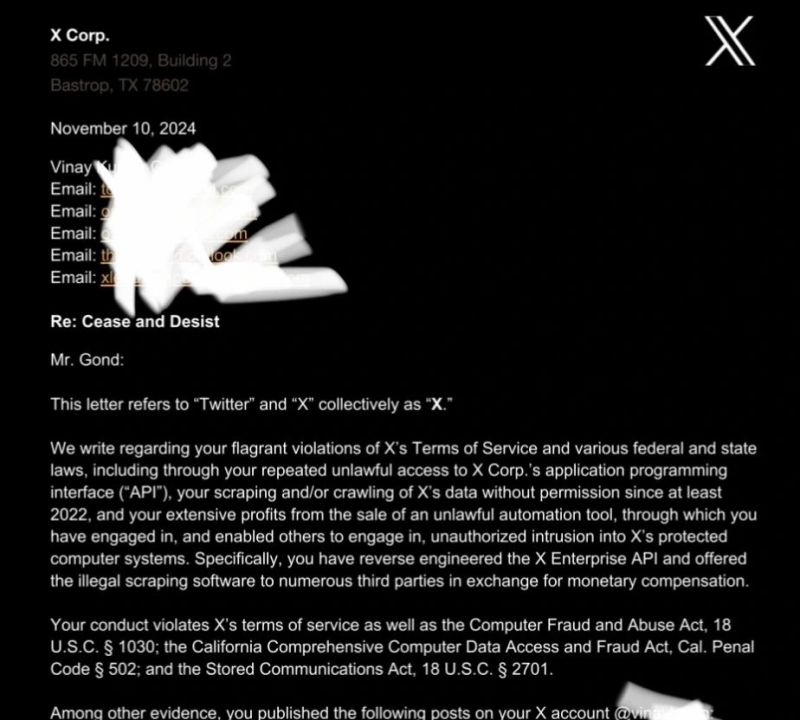
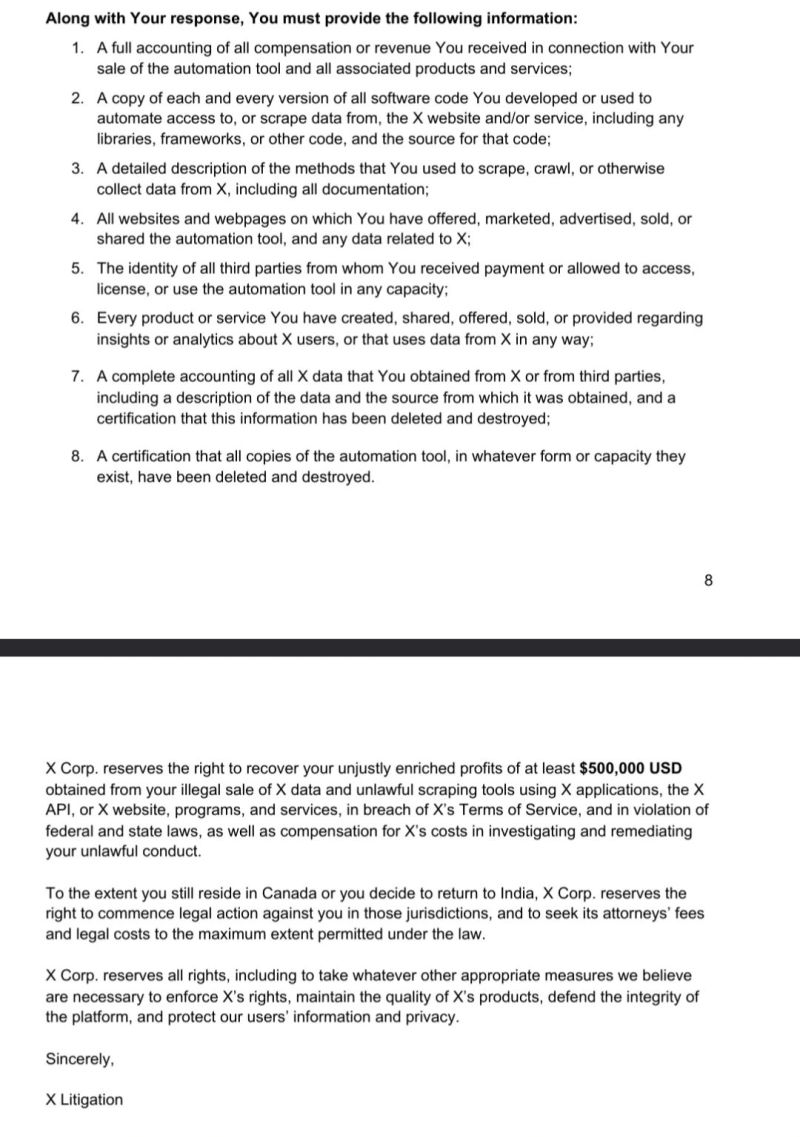
The $500K Cease-and-Desist Report
Public Engineering Postmortem · Educational Artifact
| Format | GitHub repo + interactive HTML site |
| Audience | Backend engineers, founders, platform-risk teams |
| Lesson | Constraints are architecture inputs, not obstacles |
Structured case study of how Hydra / XLeadScraper scaled commercially and failed architecturally — and what the V2 compliance reset looks like in system design.
What’s inside:
| Document | Content |
|---|---|
REPORT.md |
Full narrative and architecture analysis |
docs/detection-layers.md |
Four-layer platform enforcement model |
docs/v1-vs-v2.md |
Architecture comparison and pivot checklist |
docs/lessons-for-builders.md |
Decision framework for high-stakes systems |
docs/timeline.md |
Founder arc timeline |
docs/faq.md |
Common questions |
index.html |
Interactive charts, layer tabs, V1/V2 comparison |
Portable to Exit Protocol: blast-radius control, deterministic outputs, reviewable artifacts, SHA-256 integrity, AI/determinism boundaries.
Primary source (C&D correspondence):
GitHub · Blog summary · Technical deep-dive · Author page (report site)
Algorithmic Forensic Accounting Research
Deterministic Asset Tracing & Evidence Integrity
Research on rebuilding forensic accounting as a software pipeline: OCR-assisted ingestion, LIBR state-machine tracing, Zone of Truth simulations for ambiguous transaction ordering, and cryptographic chain-of-custody.
Key ideas:
- Manual tracing bottlenecks ($50k+ cases, spreadsheet fragility, weak reproducibility)
- LIBR as deterministic state machine — not LLM guesswork
- Replenishment fallacy and why math must stay explainable
- SHA-256 evidence sealing and auditable processing history
- Matter-level isolation and private deployment for sensitive litigation
Read on Research page · Full paper PDF · Technical stack
Content Leakage Vectors in Subscription Media
Access Control, Watermarking & Platform Incentives
Research treating creator content leakage as a distributed systems and incentive-design problem — not only a moderation problem.
Proposed shift: static archive access → dynamic, traceable, atomic content access with encrypted storage, short-lived delivery tokens, forensic watermarking, and audit logs.
ZeroTrace (Security Research)
Identity-Locked Ephemeral Messaging · Internal Prototype
Weekend security experiment: can cryptographic identity binding + burn-after-reading delivery create a high-signal contact channel when public inboxes are unusable?
Not a product. Not a “bypass DMs” tool. A research prototype exploring friction, OAuth identity verification, Fernet encryption, and honest server-trust boundaries.
How these projects connect
Hydra V1 (throughput-first)
    → C&D + blast-radius lesson
        → V2 (compliance-first) + public C&D Report
            → Exit Protocol (determinism + evidence integrity)
Philosophy across all work: Use AI where it accelerates judgment. Use deterministic systems where proof requires precision. Treat constraints as architecture.
Contact: vinay@exitprotocols.com · LinkedIn · GitHub · Technical stack · Research
Last updated: July 2026